


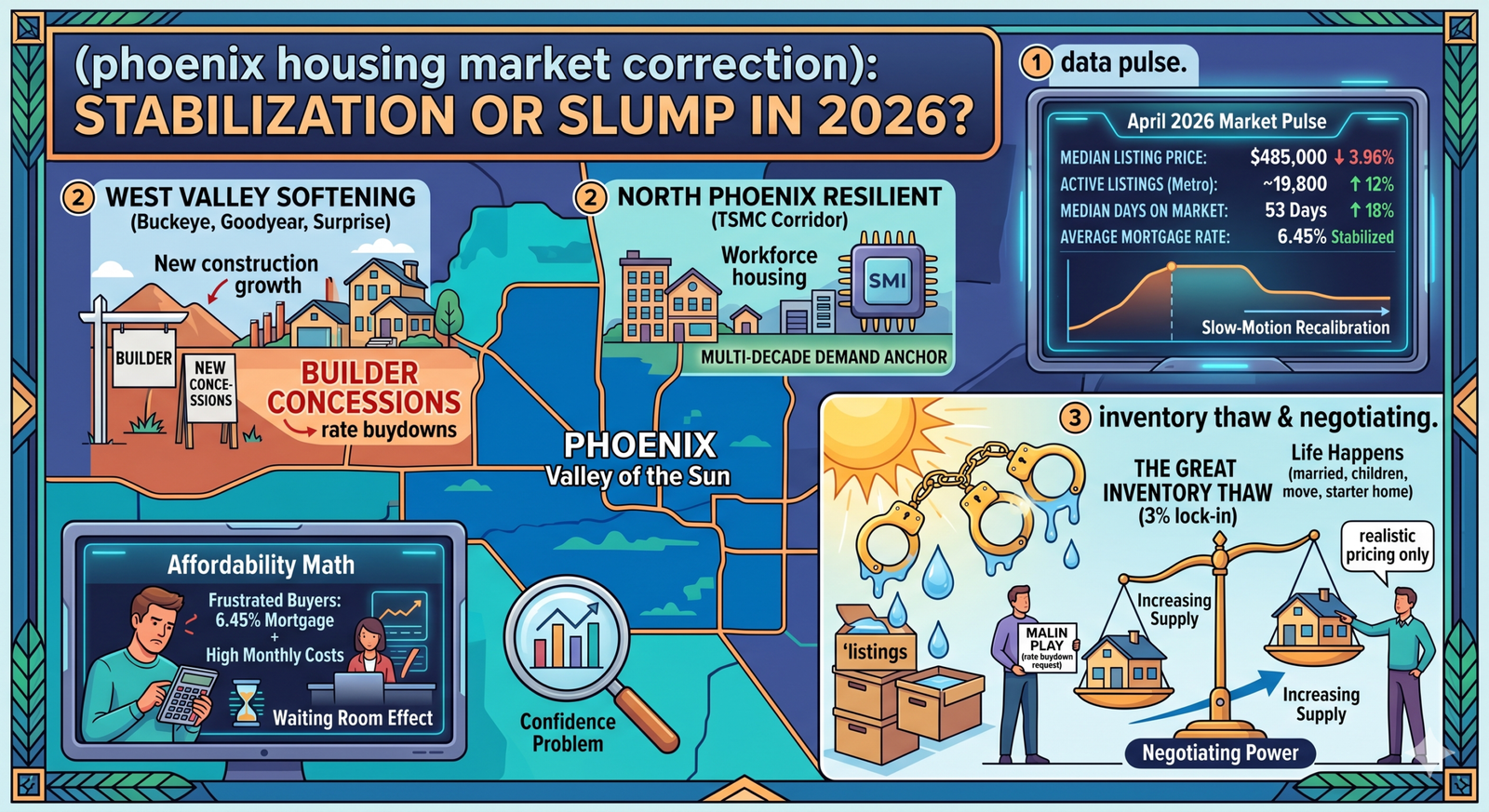
The “Valley of the Sun” has always been a place of extremes—extreme heat, extreme growth, and occasionally, extreme real estate cycles. As we move through April 2026, the term “(phoenix housing market correction)” has transitioned from a whispered fear in investor boardrooms to a daily reality for homeowners and prospective buyers across Maricopa County.
For those who lived through the “demand shock” of the early 2020s, the current landscape feels like a strange, slow-motion recalibration. We aren’t seeing the dramatic, cliff-dive “crash” of 2008, but we are undeniably in a period of correction. Prices are “sticky,” inventory is building, and the power dynamic that once favored sellers with an almost predatory intensity has finally, stubbornly shifted toward a balanced equilibrium.
1. Defining the Correction: By the Numbers
To understand where we are, we have to look at the data. In April 2026, the median listing price in the Phoenix metro area sits at approximately $485,000. While that might sound high to those who bought in 2019, it represents a year-over-year decline of roughly 4% from the same period in 2025.
This is the classic definition of a market correction: a localized decline followed by a period of sideways movement. In Phoenix, the “peak” of the frenzy has been shaved off, but the floor hasn’t dropped out.
April 2026 Market Pulse
| Metric | Current Status (April 2026) | Year-Over-Year Change |
| Median Listing Price | $485,000 | ↓ 3.96% |
| Active Listings (Metro) | ~19,800 | ↑ 12% |
| Median Days on Market | 53 Days | ↑ 18% |
| Average Mortgage Rate | 6.45% | Stabilized |
2. The “Confidence Problem” and the 6.4% Ceiling
The primary engine behind this (phoenix housing market correction) isn’t a lack of people wanting to live in Arizona; it’s a confidence problem driven by affordability math. While mortgage rates have finally “eased” into the mid-6% range, they haven’t reached the 5% levels many buyers were holding out for.
When you combine a 6.45% interest rate with a $485k price tag, the monthly carrying cost for a standard single-family home remains out of reach for a significant portion of the local workforce. This has created a “waiting room” effect. Buyers are standing on the sidelines, not because they don’t want to buy, but because the math simply doesn’t work for their household budget.
3. The Great Inventory Thaw
One of the most defining characteristics of the 2026 market is the surge in inventory. For years, we talked about a “lock-in” effect, where homeowners refused to sell because they didn’t want to trade their 3% mortgage for a 7% one.
In 2026, that “golden handcuff” has begun to rust. Life happens—people get married, take jobs in other states, or simply grow tired of living in a starter home that they’ve outgrown. As a result, active listings have climbed significantly. For the first time in nearly five years, a buyer can walk into a home on a Saturday, think about it on Sunday, and make an offer on Monday without worrying that ten other people have already bid $50,000 over asking price.
4. Neighborhood Nuance: A Tale of Two Valleys
One of the biggest mistakes people make when discussing the (phoenix housing market correction) is treating the entire Valley like a monolith. In 2026, the correction is hitting different cities with varying levels of intensity.
The “Cold” Pockets (West Valley)
Areas like Buckeye, Goodyear, and Surprise have seen some of the most significant price softening. These regions saw aggressive new construction expansion during the boom. Now that supply has finally caught up with—and in some cases, exceeded—demand, builders are offering massive concessions and rate buydowns to move inventory, which in turn drags down the resale value of existing homes in the neighborhood.
The “Resilient” Core (East Valley & TSMC Corridor)
In contrast, parts of Gilbert, Chandler, and North Phoenix remain relatively “sticky.” The North Phoenix corridor is buoyed by the continued massive investment in the TSMC semiconductor project, which is creating a multi-decade demand anchor for workforce housing. While these areas aren’t immune to the correction, their proximity to high-wage, high-tech jobs provides a “valuation floor” that the further-out suburbs lack.
5. The “New Normal”: Advice for 2026
If you are navigating this market today, the rules of engagement have changed.
-
For Sellers: You are no longer the one holding all the cards. In 2026, the “Price It and They Will Come” strategy is dead. To sell a home today, it must be pristine and realistically priced. If your home sits for more than 40 days, the market is telling you your price is 3-5% too high.
-
For Buyers: This is the best negotiating environment you’ve had since 2019. Don’t just look at the list price—look at the seller concessions. Asking for a 2-1 rate buydown or $10,000 in closing costs is now standard practice rather than an insult.
-
For Investors: The “fix-and-flip” margins have thinned. The 2026 play is long-term rentals or Short-Term Rental (STR) opportunities in established corridors like Scottsdale where demand durability remains high.
Conclusion: Is This the Bottom?
Predictions in real estate are notoriously difficult, but the 2026 (phoenix housing market correction) feels like a return to sanity rather than a descent into chaos. We are seeing a “normalization” where homes are once again treated as places to live rather than speculative assets.
While prices may continue to drift slightly lower through the end of the year, the underlying fundamentals of the Valley—job growth, migration, and a persistent (though improving) housing shortage—suggest that we are nearing the “new floor.” Phoenix isn’t going cold; it’s just finally cooling down to a temperature that’s actually livable.
read also : Sharon Mobley Stow: The Quiet Strength of a Professional Life in the Public Eye
