

In the business landscape of 2026, agility is no longer just a buzzword found in LinkedIn bios; it is the fundamental requirement for survival. We have moved past the era of digital transformation into an era of Digital Sovereignty. Companies have realized that relying solely on generic, off-the-shelf SaaS (Software as a Service) platforms is like trying to win a Formula 1 race in a rental sedan. It might get you to the finish line, but you’ll never be the fastest on the track.
If you’ve been researching custom software development, you’ve likely reached a breaking point. Perhaps your team is struggling with “subscription bloat”—paying for fifteen different platforms that don’t talk to each other. Or maybe your current tools are forcing you to change your unique business processes to fit their rigid architecture. Whatever the catalyst, the shift toward bespoke digital solutions is about taking back control of your most valuable asset: your workflow.
The “Off-the-Shelf” Trap: Why Generic Fails Scaling Businesses
Generic software is designed for the “average” user. It is built to be “good enough” for ten thousand companies, which inevitably means it is “perfect” for none of them. When you purchase a mass-market tool, you are essentially renting someone else’s logic.
In the early stages of a startup, this is a brilliant move—it’s cheap and fast. However, as a business scales, the limitations of these tools begin to act as a tax on productivity. You encounter “feature gaps” that require manual workarounds, or you find yourself paying for a “Pro Tier” just to access one specific API integration you actually need. Over time, these workarounds become technical debt, slowing down your team and creating silos of data that are impossible to analyze.
The Core Advantages of Custom Software Development
Choosing to build your own platform is an investment in the long-term infrastructure of your company. It is the “tailored suit” of the digital world—measured to your specific proportions and designed to move exactly how you do.
1. Total Scalability and Flexibility
Custom software is built with your five-year plan in mind. Unlike SaaS platforms that might deprecate a feature you rely on or change their pricing model overnight, a custom solution grows with you. If you need to pivot your business model in six months, your software can be updated to accommodate that change without you having to migrate to a new provider.
2. Seamless Integration (The “Single Source of Truth”)
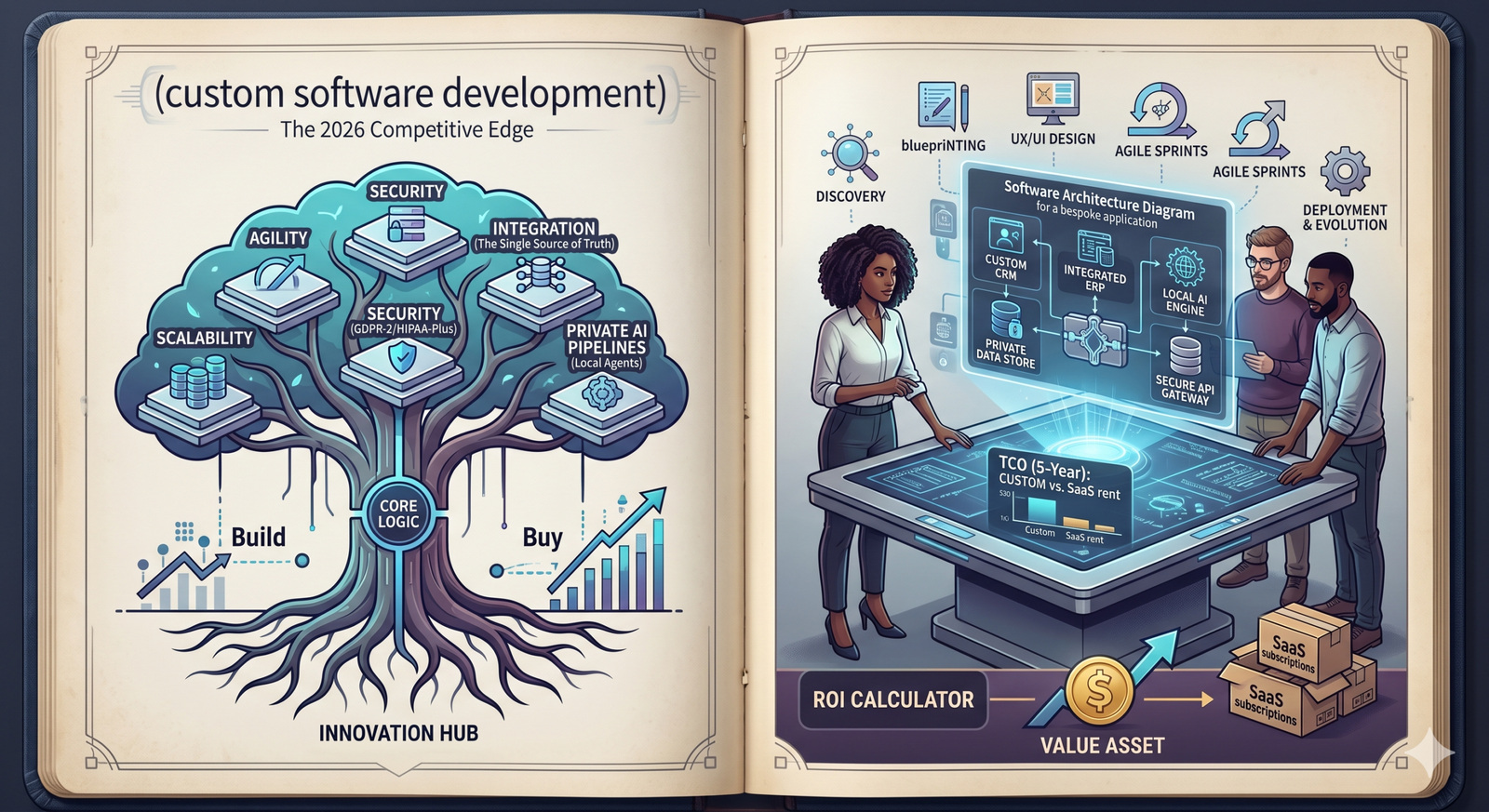
Most modern businesses operate using a “tech stack” that looks like a patchwork quilt. Custom software acts as the thread that pulls it all together. By building bespoke integrations, you can ensure that data flows seamlessly from your CRM to your accounting software to your project management tools. This eliminates manual data entry, reduces human error, and provides leadership with a Single Source of Truth.
3. Enhanced Security and Compliance
In 2026, data breaches are more sophisticated than ever. Off-the-shelf software is a high-value target for hackers because a single vulnerability can provide access to thousands of companies. Custom software, by its very nature, is a smaller target. Because the code is unique to your organization, it is much harder for generic exploits to find a way in. Furthermore, you can build in specific compliance protocols (like GDPR-2 or HIPAA-Plus) that are exactly tailored to your industry’s requirements.
Custom Software in 2026: The AI Frontier
We cannot discuss software today without talking about Artificial Intelligence. However, the “AI” found in most generic tools is often a “wrapper”—a basic connection to a public model like GPT-4 that offers little in the way of true competitive advantage.
Custom software development in 2026 allows you to build Private AI Pipelines. Instead of sending your sensitive company data to a public cloud, you can develop local AI agents that live within your own infrastructure. These agents can learn your specific brand voice, analyze your historical sales data, and automate your specific SEO or content generation workflows with 100% accuracy and privacy.
The Development Lifecycle (SDLC): What to Expect
Building custom software is a journey, not a transaction. A professional development process typically follows these four stages:
-
Discovery & Blueprinting: This is the most critical phase. Developers work with you to map out every “user story” and technical requirement. You wouldn’t build a house without a blueprint; you shouldn’t write a line of code without a Discovery document.
-
UX/UI Design: Before any back-end work begins, the “look and feel” is established. In 2026, this focus is on minimalist, high-performance interfaces that reduce “click-fatigue.”
-
Agile Development: The software is built in “sprints.” You see progress every two weeks, allowing you to provide feedback and make course corrections in real-time.
-
Deployment & Continuous Evolution: Once the software goes live, the work isn’t done. Custom software is a living asset that requires regular updates and maintenance to stay ahead of the competition.
Calculating the ROI: Is it Worth the Upfront Cost?
The biggest hurdle to custom development is the initial price tag. It is undeniably more expensive to build than to subscribe—initially. However, the Total Cost of Ownership (TCO) over five years often tells a different story.
| Metric | Off-the-Shelf SaaS | Custom Software |
| Upfront Cost | Low (Monthly sub) | High (Development fee) |
| Ownership | You rent it (License) | You own it (IP Asset) |
| Flexibility | Limited (Roadmap-dependent) | Infinite (You set the roadmap) |
| Scalability Cost | Increases per user/seat | Flat (Scales with server costs) |
| Competitive Edge | Zero (Everyone has it) | High (It’s your secret sauce) |
If you have 50 employees and are paying $100/month per seat for a suite of tools, that’s $60,000 a year in “rent” for software you will never own. Over five years, that’s $300,000. For that same amount, many mid-sized companies could build a proprietary tool that eliminates those fees entirely and becomes a sellable asset for the company.
Conclusion:
Own Your Innovation
In a world where everyone has access to the same basic digital tools, the only way to truly stand out is through the quality of your systems. Custom software development is no longer a luxury reserved for the Fortune 500; it is a strategic necessity for any business that wants to protect its margins, empower its employees, and own its future.
read also : Phoenix Housing Market Correction: Stabilization or Slump in 2026?
