


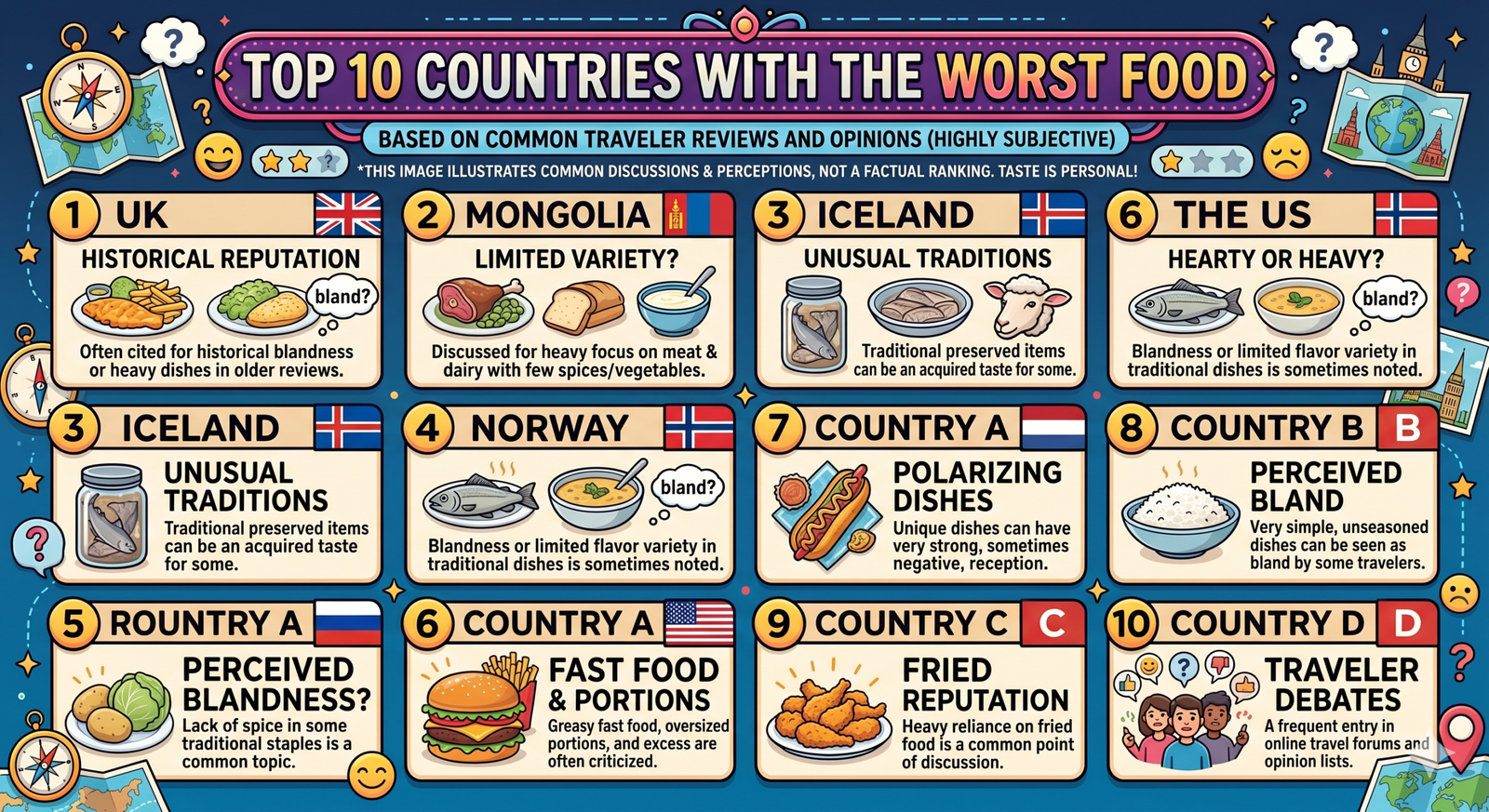
Introduction: The Myth of the “Worst” Cuisine
When searching for the top 10 countries with the worst food, it is crucial to understand one fundamental truth: such assessments are entirely subjective and depend heavily on diverse cultural perspectives and individual palates. What one person considers a flavorless or bizarre meal, another cherishes as a deeply comforting, traditional delicacy.
Often, when a country’s cuisine is labeled as “bad,” it simply means it is unfamiliar to the global majority. Many traditional diets were born out of absolute necessity. In harsh, freezing climates, ancient people had to rely on extreme preservation methods—like fermentation, curing, and pickling—just to survive the winter. In nomadic cultures, a lack of agriculture meant diets were strictly limited to meat and dairy.
Instead of providing a definitive ranking, this article explores ten countries that frequently appear on travel forums, subjective foodie lists, and culinary databases (like TasteAtlas) for having highly polarizing, unusual, or challenging foods. Let’s dive into the fascinating history and cultural context behind the world’s most debated cuisines.
Iceland: A Tale of Survival and Fermentation
Iceland frequently tops lists discussing challenging food, largely due to its historical reliance on extreme preservation techniques. In a climate where growing fresh vegetables was historically nearly impossible, Icelanders turned to the sea and their livestock.
The Polarizing Dishes: Hákarl (fermented shark) is infamous worldwide for its overwhelming ammonia aroma. Another traditional staple is Svið (singed and boiled sheep’s head), which is eaten whole, including the eyes.
The Verdict: While tourists often find these dishes visually and aromatically shocking, they are celebrated during the mid-winter festival of Þorrablót as a proud reminder of Icelandic resilience.
Sweden: Blood Dumplings and Bizarre Pizzas
While Swedish meatballs and lingonberry jam are globally beloved, some of Sweden’s deeper traditional and modern street foods can leave foreigners bewildered.
The Polarizing Dishes: Blodplättar (blood pancakes) and Blodpalt (dark dumplings made with rye flour and animal blood) are nutrient-dense foods that have sustained Northern Swedes for generations, but their metallic taste is an acquired one. On the modern end, Sweden is famous for bizarre pizza toppings, including the Pizza Vulkanen—a massive ring of dough stuffed with steak, fries, béarnaise sauce, and salad.
The Verdict: Swedish food is highly practical, but its traditional use of blood and modern chaotic fast-food mashups often clash with international expectations.
The United Kingdom: Battling a Historical Reputation
The joke that Britain has terrible food is a long-standing international trope. While London is now one of the greatest culinary capitals in the world, the UK’s traditional working-class foods often face harsh criticism from outsiders who find them bland or overly heavy.
The Polarizing Dishes: Jellied eels—a traditional East London street food served cold in a savory gelatin—frequently rank among the most disliked foods in Europe. Scotland’s Haggis (sheep’s pluck mixed with oats and spices, encased in an animal stomach) is delicious to many but sounds terrifying to the uninitiated.
The Verdict: The UK suffers from post-war stereotypes of boiled vegetables and unseasoned meats. Today, the reality is much more delicious, though the historical classics remain heavily debated.
visit also : trendlymora.com
Norway: Lye-Treated Fish and Hearty Stews
Similar to Iceland, Norway’s traditional cuisine was shaped by the brutal necessity of surviving long, dark winters. The focus is heavily on fish, root vegetables, and preservation.
The Polarizing Dishes: Lutefisk is perhaps the most notorious. It is dried whitefish treated with lye, resulting in a gelatinous, wobbly texture that even many Norwegians only eat out of obligation during the holidays. Rakfisk (fermented trout) is another pungent dish that challenges foreign noses.
The Verdict: Norwegian cuisine prioritizes sustenance over complex spice profiles, which can make it taste flat or overly pungent to international visitors.
Mongolia: The Nomadic Diet
Mongolian cuisine is a direct reflection of its people’s nomadic heritage and the harsh, arid steppes they call home. Because agriculture is incredibly difficult in Mongolia, the diet is almost entirely devoid of fresh vegetables and spices.
The Polarizing Dishes: The cuisine is heavily reliant on meat (often mutton), animal fats, and dairy. Airag (fermented mare’s milk) is a staple beverage that offers a sour, slightly alcoholic kick. Boiled mutton with no seasoning other than salt is a daily standard.
The Verdict: For visitors accustomed to herbs, spices, and fresh greens, the heavy, fatty, and unseasoned nature of traditional Mongolian food can be incredibly difficult to digest.
The Netherlands: A Culture of Fried Snacks
Dutch food rarely wins awards for sophistication. The culinary culture in the Netherlands has historically been Calvinist—food is seen as fuel rather than an art form.
The Polarizing Dishes: The traditional Dutch dinner often consists of Stamppot (mashed potatoes mixed with a single vegetable, served with a sausage). Furthermore, their street food culture is entirely dominated by deep-fried snacks from vending machines, such as Nasibal (deep-fried balls of leftover noodles) or Frikandel (a skinless, deep-fried meat sausage of ambiguous origins).
The Verdict: Expats often note that traditional Dutch food is monotonous and lacks culinary ambition, leaning heavily on carbohydrates and deep-fryers.
Russia: The Kingdom of Aspic
Russian cuisine is hearty, designed to warm the body during freezing winters. However, their love for specific textures—particularly gelatinous ones—often lands them on lists of the world’s most misunderstood foods.
The Polarizing Dishes: Kholodets is a traditional meat jelly made by boiling animal bones and meat until a natural gelatin forms, served cold. Another staple is Dressed Herring (often called “Herring Under a Fur Coat”), a layered salad of pickled fish, boiled root vegetables, and heavy mayonnaise.
The Verdict: Western palates are often averse to savory, cold, gelatinous textures, making traditional Russian holiday tables a daunting sight for tourists.
Chile: Starchy Island Breads
South America is globally renowned for its vibrant, spicy, and fresh cuisines. However, some regional dishes in Chile, particularly those from the Chiloé Island, have drawn the ire of global food raters.
The Polarizing Dishes: Chapalele and Milcao are traditional Chilean potato breads/dumplings. While they represent deep cultural history and are traditionally cooked in a curanto (an underground pit), they are heavily criticized by international foodies for being overwhelmingly dense, starchy, and entirely lacking in flavor.
The Verdict: It’s a classic case of comfort food missing the mark for outsiders who expect the zesty, bright flavors typically associated with Latin America.
Thailand: The Bug Street Food Phenomenon
It might seem shocking to see Thailand—a country globally worshipped for its complex, sweet, sour, and spicy cuisine—on a list like this. However, it perfectly illustrates why assessing food is subjective.
The Polarizing Dishes: While Pad Thai and Green Curry are beloved, Thailand’s street food culture also includes Hon Mhai (deep-fried silkworms) and other insects like crickets and water bugs.
The Verdict: To locals, these are cheap, highly sustainable, and crunchy protein snacks. To many Western tourists, the psychological barrier of eating insects earns these specific dishes a spot on the “worst foods” lists, despite the rest of the country’s culinary brilliance.
The Philippines: The Challenge of Balut
Filipino cuisine is a beautiful, rich melting pot of Malay, Spanish, and Chinese influences, featuring incredible dishes like Adobo and Lechon. Yet, it frequently gets dragged into “worst food” discussions because of one specific, highly polarizing street food.
The Polarizing Dishes: Balut is a fertilized duck egg that is incubated for 14 to 21 days, boiled, and eaten directly from the shell. It includes a partially formed duck embryo.
The Verdict: While it is a beloved, savory, protein-packed street food in the Philippines, the visual and textural reality of eating a partially formed bird makes it an insurmountable hurdle for many global tourists.
Conclusion: Beauty is in the Eye of the Beholder
When we look for the top 10 countries with the worst food, what we are really finding is a map of global survival, history, and human ingenuity. A dish born from the necessity of surviving an Arctic winter or a nomadic lifestyle should not be judged by the same metrics as a meal prepared in a lush, tropical agricultural hub.
Read also : The Great Culinary Debate: What Country Has the Worst Food?
Is there an official list of the countries with the worst food?
No, there is no official or scientific list. Any ranking of the “worst food” is entirely subjective and based on individual traveler opinions, cultural biases, and online polls. What one culture considers a pungent, unappetizing dish, another culture views as a beloved, traditional delicacy.
Why is British food often stereotyped as being bad?
The UK’s culinary reputation suffered heavily during and after World War II due to strict rationing, which led to a reliance on plain, boiled, and unseasoned foods. While this stereotype of “blandness” has lingered in pop culture, modern Britain—especially cities like London—actually boasts one of the most diverse, vibrant, and highly-rated culinary scenes in the world today.
What makes traditional Nordic food (like in Iceland or Norway) so challenging for foreigners?
Historically, Nordic countries faced brutal, freezing winters where growing fresh produce was impossible. To survive, locals had to rely heavily on extreme preservation methods like curing, drying, smoking, lye-treating, and fermenting meats and fish. While these strong-smelling and intensely flavored preserved foods are culturally significant, they can be highly overpowering for tourists accustomed to fresh ingredients and spices.
Should I avoid eating local food in countries known for having “bad” cuisine?
Absolutely not! Trying local food is one of the best ways to understand a country’s history and culture. Even in countries that appear on “worst food” lists, you will find incredible regional specialties, comforting stews, and unique street foods. Always keep an open mind; you might discover a new favorite dish that simply doesn’t exist back home.
Why do some cultures eat insects or partially formed embryos like Balut?
Food is deeply tied to geography and resource availability. In many parts of Southeast Asia, insects provide a cheap, sustainable, and highly nutritious source of protein. Similarly, dishes like Balut in the Philippines are celebrated as hearty, energy-boosting snacks. While the visual aspect may be a psychological hurdle for Western tourists, these foods are completely normal, safe, and delicious to the locals who grew up eating them.
