


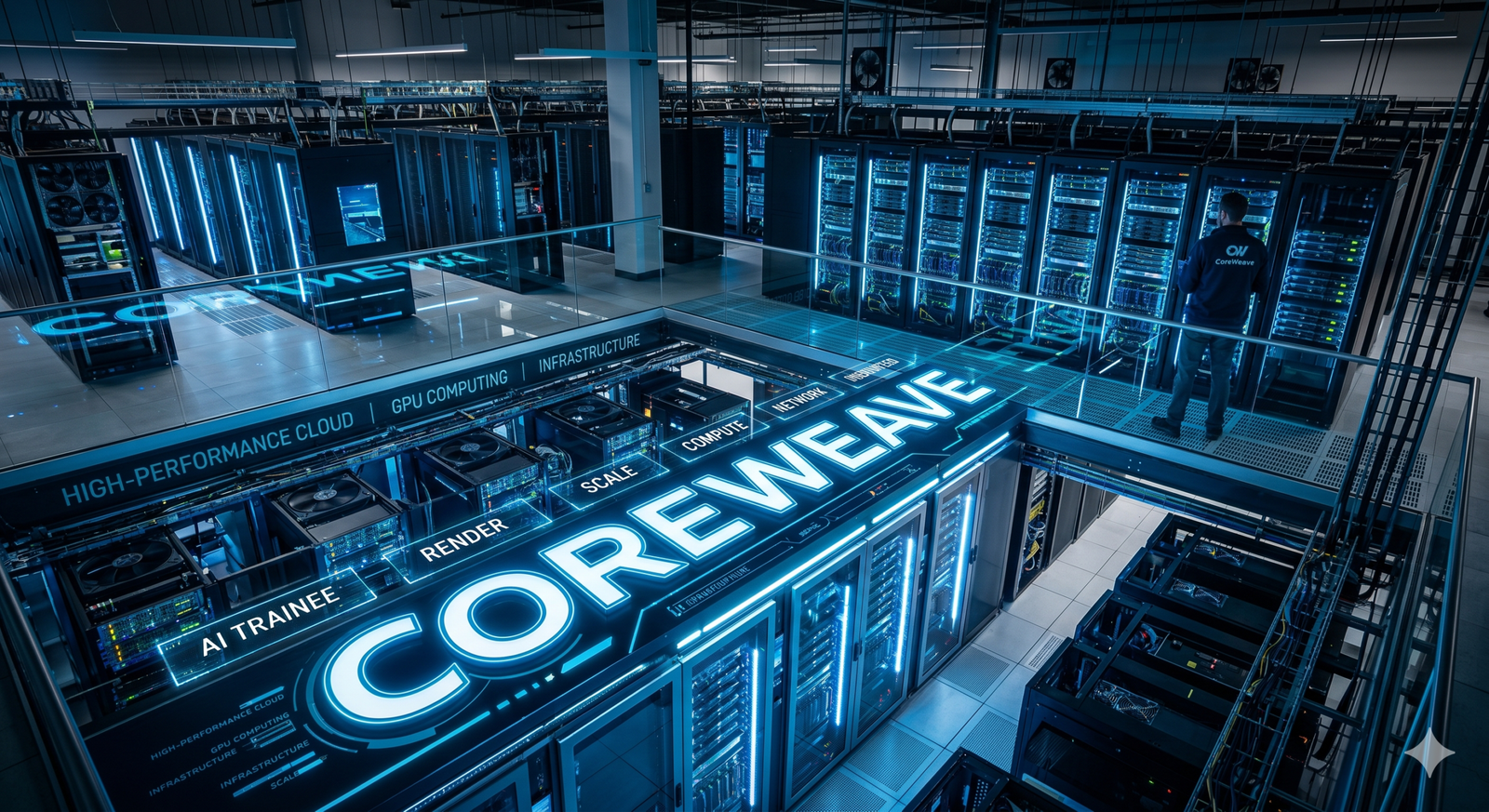
In the rapidly evolving landscape of artificial intelligence, a single name has dominated headlines over the past year: CoreWeave. Once a humble cryptocurrency mining operation, the New Jersey-based company has pivoted to become the most critical infrastructure provider for the generative AI boom. As of May 2026, CoreWeave is no longer just a startup; it is a global powerhouse challenging the traditional dominance of Amazon, Google, and Microsoft.
From Crypto Mining to AI Backbone
The story of CoreWeave is one of the most successful strategic pivots in tech history. Founded in 2017, the company originally focused on mining Ethereum. However, the founders quickly realized that the specialized hardware they were using—NVIDIA Graphics Processing Units (GPUs)—had a far more valuable application: high-performance computing.
By 2026, CoreWeave has established itself as the premier “GPU cloud” provider. Unlike legacy cloud giants that offer a broad suite of general-purpose services, CoreWeave is built from the ground up to handle the massive, parallel processing workloads required to train and run Large Language Models (LLMs) like GPT-5 and Claude 4.
The Massive 2024-2025 Funding Surge
To understand where CoreWeave stands today, one must look at the unprecedented capital influx it experienced. In mid-2024, the company secured a $7.5 billion debt facility led by Blackstone, followed by an equity round that valued the company at $19 billion.
This capital wasn’t just for operations; it was for an aggressive, multi-continent infrastructure build-out. CoreWeave’s strategy has been to purchase as many NVIDIA H100, H200, and Blackwell B200 GPUs as possible, often securing supply even when the “Big Three” cloud providers were facing shortages.
Recent News: Global Expansion and the Blackwell Era
As we move through 2026, the latest CoreWeave news centers on three major pillars: international footprint, hardware superiority, and a rumored IPO.
1. The European Offensive
CoreWeave recently announced the opening of three massive data centers in Europe, specifically in Norway, Sweden, and the UK. This move is designed to address the growing demand for “sovereign AI”—allowing European governments and corporations to process data locally to comply with strict GDPR and AI Act regulations.
2. Early Adoption of NVIDIA Blackwell
CoreWeave was among the first cloud providers to deploy NVIDIA’s Blackwell architecture at scale. While competitors were still optimizing H100 clusters, CoreWeave’s nimble, specialized infrastructure allowed them to offer B200 instances to AI labs months ahead of the traditional market. This “speed-to-market” has made them the preferred partner for startups like Mistral and Perplexity.
3. The Path to IPO
Speculation has reached a fever pitch regarding CoreWeave’s initial public offering. Analysts suggest that given their current revenue trajectory—driven by multi-year, multi-billion dollar contracts with firms like Microsoft—CoreWeave could be looking at one of the largest tech IPOs of 2026.
Why CoreWeave is Beating the Giants
You might wonder how a relatively small company can compete with the likes of Amazon Web Services (AWS). The answer lies in specialization.
-
Bare Metal Performance: CoreWeave offers “bare metal” instances, meaning there is no virtualization layer between the AI model and the GPU. This results in significantly lower latency and higher performance for training cycles.
-
Scale of Clusters: They specialize in massive clusters. Training a modern AI model requires thousands of GPUs working in perfect sync. CoreWeave’s network architecture is designed specifically for this “InfiniBand” connectivity.
-
The NVIDIA Partnership: It is no secret that CoreWeave has a “special relationship” with NVIDIA. By being a dedicated partner that focuses solely on GPU compute, they often receive priority allocations of the most sought-after chips on the planet.
The Impact on the AI Ecosystem
CoreWeave’s rise has democratized access to high-end compute. By providing a scalable, pay-as-you-go model for the world’s most powerful chips, they have allowed mid-sized AI startups to compete with Big Tech. Without CoreWeave, the AI industry might have become a duopoly; instead, it is a vibrant ecosystem of competing models.
However, the journey hasn’t been without its skeptics. Some critics point to the company’s heavy debt load and the potential risk of a “GPU bubble.” If the demand for generative AI were to cool, CoreWeave’s massive investment in hardware could become a liability. But for now, with AI integration becoming a standard for every Fortune 500 company, that risk seems far on the horizon.
Conclusion: The Future of Compute
As of May 2026, CoreWeave stands as a testament to the power of specialized infrastructure. They have proven that in the age of AI, being a “jack of all trades” is less valuable than being the master of one: the GPU.
Whether they remain an independent cloud powerhouse or eventually become part of a larger tech conglomerate, CoreWeave’s impact on the speed and scale of AI development is undeniable. They aren’t just following the news; they are the ones making it
read also : Jessica Ezratti: The Power of Private Influence and Shared Values in Florida Real Estate
